Gold Hallmarking Explained: What Every Jewellery Buyer Should Check
Gold jewellery carries financial and personal value, so confirming its purity before payment is an important part of the buying process. Gold hallmarking provides a recognised way to check the declared fineness of an ornament and identify the marks recorded under India’s official system. A polished finish, a familiar design or a seller’s assurance cannot establish gold content on its own.
It is important that the buyer verifies the hallmark, confirms the unique identifier number, if present, and checks whether it matches the product description and invoice. This will help in keeping a clear record of the purchase and avoid misunderstandings once the transaction is completed.
What Is Gold Hallmarking?
Gold hallmarking is explained as the process of testing jewellery against the relevant purity standard and marking an article that meets the prescribed requirements. The Bureau of Indian Standards (BIS) operates the hallmarking scheme. The BIS-recognised Assaying and Hallmarking Centres test articles submitted through the system. The mark ensures that there is assurance from a third party about the fineness of the gold and makes comparisons easier for the consumer.
A hallmark confirms information about gold purity, not every aspect of an ornament. It does not certify the originality of the design, stone-setting quality, clasp strength, workmanship or resale price. Buyers should inspect these features separately and treat hallmarking as one essential part of the purchase review.
What Are the Different Components of a Gold Hallmark?
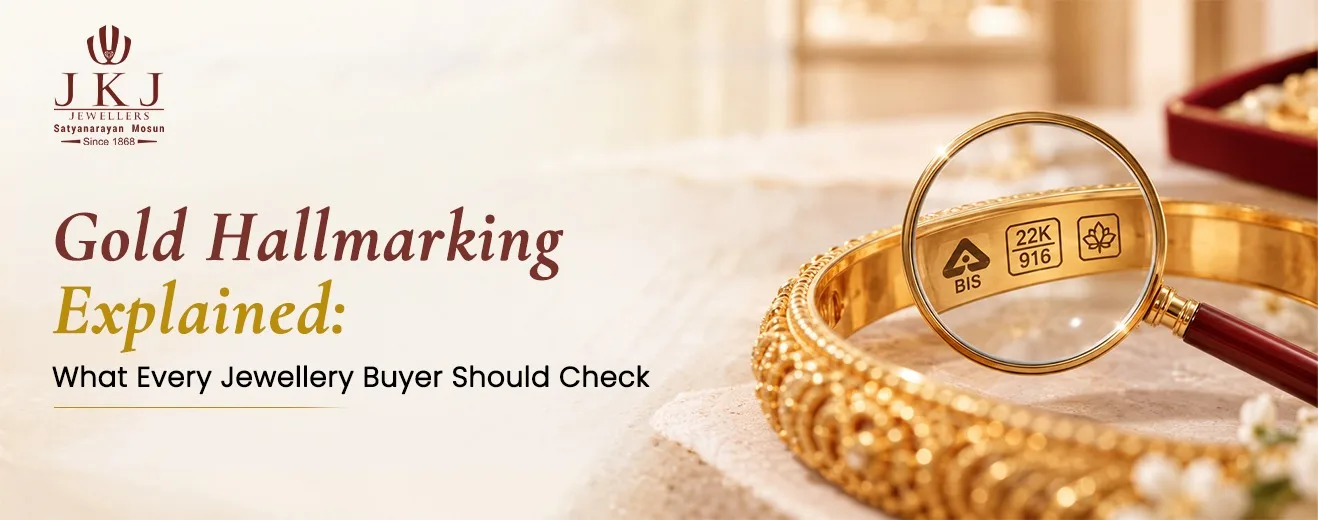
A standard BIS hallmark on eligible gold jewellery contains three marks: the BIS Standard Mark, the purity or fineness mark, and a six-character alphanumeric Hallmark Unique Identification number (HUID). Each provides distinct information. So the marks should be checked together.
BIS Standard Mark
The BIS hallmark on gold jewellery includes the BIS logo, identifying the article as marked under the Bureau of Indian Standards hallmarking system. Inspect the symbol carefully because a mark that merely resembles the official logo does not establish authenticity. Ask for a magnifier if the detail is difficult to see, and check the logo alongside the purity mark and HUID.
Purity or Fineness Mark
The purity mark states the declared gold content. For example, 22K916 indicates 22-karat gold with a fineness of 916 parts per thousand, while 18K750 indicates 18-karat gold with a fineness of 750 per thousand. Karat measures gold purity on a 24-part scale; fineness expresses gold content in 1,000 parts of the alloy. Other metals are added to provide properties such as strength, colour or workability. The mark should match the purity stated on the product tag and invoice.
Hallmark Unique Identification (HUID) Number
The HUID is a six-character alphanumeric code assigned to an individual hallmarked jewellery article. It links the item to BIS hallmarking records and can be checked through the official BIS Care app. Since each code relates to a specific article, verify the number on the ornament selected, not on a display piece or a similar design.
How to Check a Gold Hallmark Before Buying Jewellery
Knowing “ details” helps buyers compare the physical marking with official records and the seller’s information. Inspect the marks, verify the HUID where applicable, and compare the details with the product description and invoice before paying.
Look for the Hallmark on the Jewellery
Mark placement varies with the shape and construction of an ornament. Rings may carry marks on the inner band, while bangles may have them near an inside edge or clasp. Necklaces and chains may carry marks on a tag, clasp or another suitable area. Small markings can require good lighting and magnification, so ask the jeweller to show them clearly before packing the item. Do not rely on a photograph of a different piece.
Verify the HUID Number
To check the HUID number on gold jewellery, open the official BIS Care app and select “Verify HUID.” Enter the six-character code exactly as marked, then compare the displayed article details and purity with the ornament in front of you. Check every character carefully, since a typing error can affect the result. Do not rely on a number printed on a tag if it differs from the code engraved on the article. A mismatch requires clarification before purchase.
If the code is unreadable or no result appears, ask the seller to check the mark and explain the issue. Avoid treating one failed check as conclusive proof of fraud, since entry errors or technical problems may need to be ruled out.
Match the Purity Mark with the Product Details
Gold jewellery purity verification means checking whether the fineness marked on the article matches the purity advertised by the seller. A piece marked 18K750 should not be described or billed as 22-karat gold. Buyers who want to get gold purity explained should ask the jeweller to clarify the karat value and fineness figure, especially when comparing items with different rates. If the tag, HUID result and salesperson’s description conflict, request an explanation before proceeding.
Check the Invoice
Review the invoice for the item description, purity in karat and fineness, net gold weight, hallmarking charges where applicable, making charges, stone or other material details, taxes and final amount payable. Net gold weight should be distinguishable from the total weight of an ornament containing stones, beads, enamel or other materials. You should always confirm that the listed charges match the price discussion. Also, keep the invoice and payment record safely for exchange, resale discussions or a future complaint.
You should enquire how precious stones’ weight and value are calculated and whether the stated gold weight excludes them. The clear itemisation helps prevent confusion when assessing the gold component separately from decorative materials.
Is All Gold Jewellery Hallmarked in India?
Mandatory hallmarking applies according to the districts and product categories covered by the applicable government order, subject to specified exemptions. BIS guidance lists exemptions for articles weighing less than two grams, certain export or exhibition jewellery, gold thread, watches and fountain pens, and special categories such as Kundan, Polki and Jadau jewellery. Provisions also apply to jewellers below the stated annual turnover threshold. As orders can be amended, check BIS guidance for the rules relevant to the item and location.
The absence of a hallmark does not automatically prove an ornament is counterfeit. The piece may be exempt, older, or require further clarification about the circumstances of sale. However, buyers should question a vague explanation when the item appears to fall under mandatory requirements.
Ask the seller why hallmarking does not apply and request supporting details; for an item that must be hallmarked, confirm the required marks before paying. The product category, weight, sale location and applicable order may affect the requirement, so confirm the position for the actual item rather than relying on a general statement about all gold ornaments.
Common Gold Hallmarking Mistakes Buyers Should Avoid
- Treating a karat or fineness number as a complete hallmark without checking the BIS mark and HUID where required.
- Accepting a seller’s verbal assurance instead of inspecting the marks and verifying available details.
- Skipping the HUID check on an article that carries a HUID.
- Ignoring differences between the ornament, app result, product tag and invoice.
- Judging authenticity only by colour, shine, design, weight or an unusually attractive price.
What Should You Do If a Gold Hallmark Cannot Be Verified?
A failed verification calls for review rather than an immediate conclusion. Keep the ornament in view, note the marking and ask the jeweller to check the details.
- Ask the seller to clarify the mark, purity and HUID results and request a written explanation if there is a difference.
- Request the product details, invoice, payment record and relevant hallmarking information before finalising the purchase.
- If the seller is not able to sort out your issue or the details remain inconsistent, contact BIS via their official complaint channel.
- Avoid accusing the seller of fraud solely because an app check fails, since the code or technical access may need to be checked again.
How to Choose a Reliable Jeweller for Buying Hallmarked Gold
A reliable purchase depends on clear information, documented transactions and a seller who allows reasonable verification. When comparing the best jewellers in Jaipur, assess the information provided instead of relying on reputation alone.
A jewellery shop in Jaipur should be able to explain the purity mark, show the HUID where applicable and provide a detailed invoice.
- You should always look for transparent billing that identifies purity, net gold weight, item details and charges included in the final price.
- It is recommended to ask how the hallmark can be checked and request access to the marks and product documentation.
- Examine the terms and conditions relating to the refund, exchange, buy-back and repair in written form.
- Buyers researching Polki jewellery manufacturers in Jaipur should clarify the article’s category and whether an exemption applies because BIS lists Polki jewellery among exempt special categories.
- Choose a jeweller who gives clear responses to your queries and allows you to verify facts for yourself rather than relying only on reputation.
Final Checklist Before Purchasing Gold Jewellery
- Check the BIS Standard Mark where hallmarking applies.
- Verify the HUID through the BIS Care app where the jewellery carries one.
- Confirm that the purity or fineness mark matches the seller’s description.
- Check the product specifications against the invoice prior to paying.
- Consider net gold weight, making charges, processing fees, taxes and other costs.
- Keep the invoice, payment information and purchase receipts in a secure location.
Conclusion
Gold hallmarking gives buyers an established way to check the declared purity of gold jewellery, but a careful purchase also requires reviewing the HUID, product details and invoice. These steps help confirm that the ornament matches the seller’s description and provide a useful record if questions arise. Verify the marks before payment and seek clarification when details conflict. JKJ Jewellers is a place to explore jewellery while applying these checks to the purchase.
Visit JKJ Jewellers, Jaipur
See the designs in person and get honest advice from our team at any of our four showrooms.