
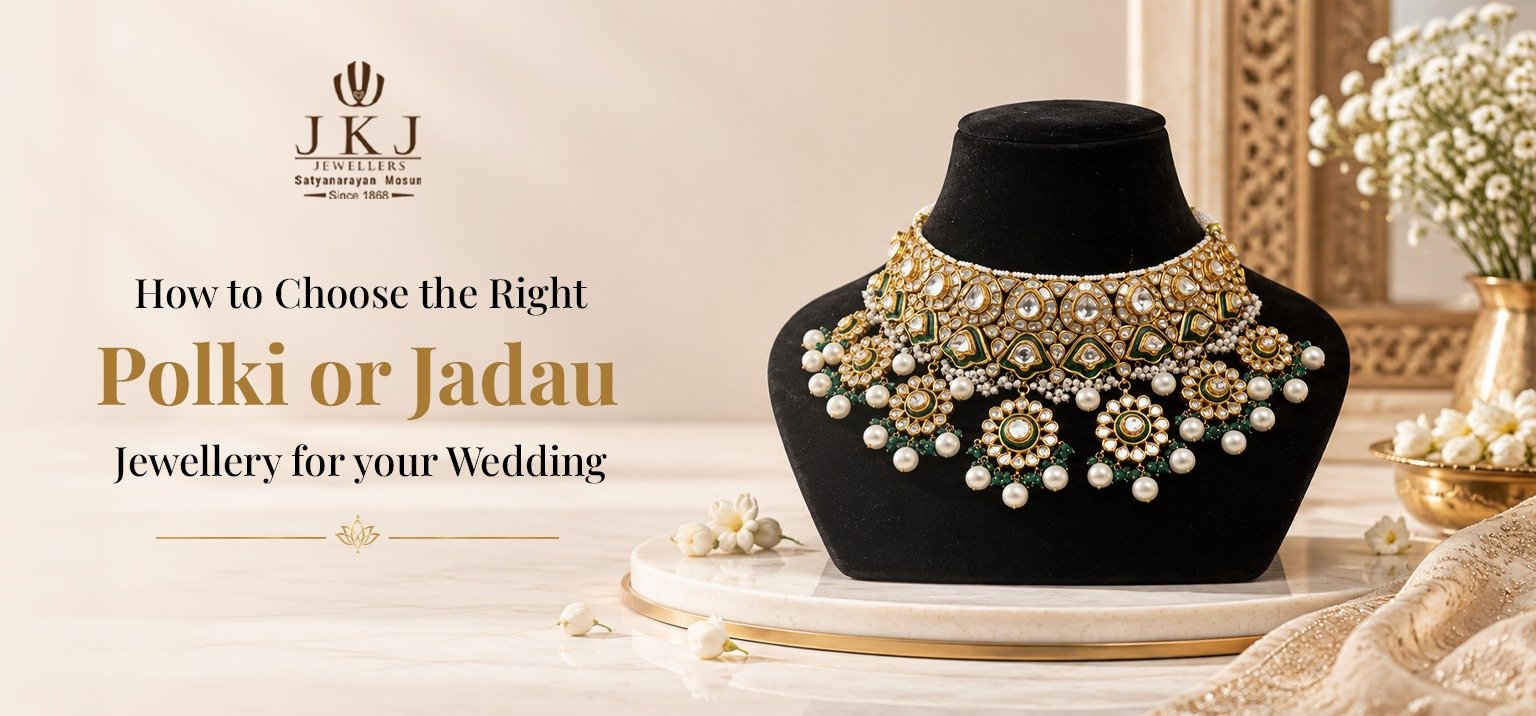
Wedding jewellery shopping usually begins with excitement and ends, more often than not, in confusion. Gold trays arrive one after another, while uncut diamonds shine differently in each set. It can be tempting to choose the heaviest or most expensive pieces without thinking carefully. But choosing Polki or Jadau bridal jewellery should complement the wedding outfit, suit the bride’s face shape, match the specific function it is being worn for, reflect her personal taste, sit well within the surrounding colour palette, stay within budget and remain usable well beyond the wedding itself.
Polki and Jadau represent two of the most respected traditions in Indian bridal jewellery, each shaped by generations of craftsmanship. Knowing what separates them, and where they overlap, helps a bride move through the selection process with far more clarity than instinct alone can offer. This blog covers outfit pairing, function-wise jewellery choices, face shape considerations, budgeting and how to evaluate a jeweller, so that the eventual decision feels settled rather than second-guessed.
Quick Answer
Polki suits brides who prefer the natural, uncut-diamond look and want jewellery that stays versatile past the wedding season. Jadau suits brides drawn to intricate traditional craftsmanship and a richer, more regal bridal appearance. The better choice, in practice, depends on the outfit, the function, personal style and budget.
Polki vs Jadau Jewellery: Understanding the Difference
Polki uses natural, uncut diamonds set into gold, giving off a raw and gentle sparkle quite unlike the sharp brilliance of faceted stones. It has long been tied to heirloom bridal jewellery and works comfortably with both classic and contemporary interpretations.
Jadau works differently. The term describes a setting technique rather than a stone, developed by craftsmen who embed uncut diamonds, polki and coloured gemstones into gold through a process refined over centuries. The result tends to carry intricate detailing and a distinctly regal weight to it.
| Feature | Polki Jewellery | Jadau Jewellery |
| Main characteristic | Uncut natural diamonds | Traditional craftsmanship and setting |
| Appearance | Soft and natural sparkle | Rich, detailed and regal |
| Best suited for | Elegant bridal looks | Grand traditional looks |
| Styling | Traditional and contemporary | Traditional and heritage-driven |
| Jewellery pieces | Necklaces, earrings and tikka | Necklaces, chokers, earrings and bridal sets |
Start With Your Wedding Outfit
Jewellery should follow the outfit’s lead, not compete with it. The lehenga’s colour, how dense the embroidery is, the neckline’s shape, the fabric’s weight and the amount of detailing on the dupatta all influence how much visual room the jewellery can reasonably occupy.
Take a heavily embroidered bridal lehenga as an example. It tends to look better paired with one well-proportioned jewellery set rather than several statement pieces stacked together, each pulling attention in a different direction.
A few things worth checking before deciding-
- The outfit’s colour against gold or gemstone tones.
- How dense or minimal the embroidery is.
- The neckline’s shape.
- The overall visual weight the ensemble already carries.
- Whether gold tones and gemstone colours sit together comfortably.
Decide Between Polki and Jadau Based on Your Bridal Style
Jaipur Polki jewellery generally appeals to brides who favour elegance over embellishment. The look feels refined and traditional, with a soft glow that suits statement pieces without looking excessive.
A Jadau-led bridal look suits brides who want their jewellery to feel regal and traditional, where layered gemstone work and detailed craftsmanship carry the presence that Polki alone rarely achieves.
None of this requires strict commitment to one tradition over the other. Many brides build a jewellery collection that borrows from both, wearing different pieces across different days without any conflict between them.
Choose Jewellery According to Your Wedding Functions
Jadau jewellery Jaipur craftsmen often point out that repeating the same set across every function tends to look flat by the third or fourth event. Varying the weight and style instead keeps each occasion visually distinct.
Wedding Ceremony
The main ceremony usually calls for heavier, more traditional pieces, given the scale and formality of the setting.
Engagement
A lighter and more versatile set works better here because the evening often involves extended photography and long hours of wear.
Mehendi
Comfortable and lighter accessories are the priority for this function, with hands remaining the visual focus throughout.
Sangeet
Contemporary or statement pieces tend to suit the energy of the evening, especially when paired with a more modern outfit.
Reception
Sophisticated, restrained pieces usually photograph best here, complementing the outfit rather than overpowering it.
There is no obligation to keep jewellery identical from one function to the next. Varying it across the celebrations, in most cases, produces a far more considered overall look.
Choose the Right Polki Jewellery for Your Wedding
Selecting from Jaipur Polki jewellery involves more than picking a necklace and moving on. Chokers work well with high necklines and structured blouses, while long necklaces suit deeper necklines and simpler bodices better. Earrings should be scaled to match the necklace rather than compete with it, and a maang tikka or nath can round off the bridal silhouette without adding unnecessary bulk.
Bangles are worth equal attention, particularly for brides who expect their hands to feature prominently in wedding photographs.
Selection generally comes down to a few factors-
- The neckline and embroidery of the outfit.
- The specific function being dressed for.
- The visual impact wanted in photographs.
- How comfortably the pieces can be worn for hours.
Choose the Right Jadau Jewellery for Your Wedding
Jadau necklaces, chokers, earrings and rani haars carry a density of craftsmanship that holds up well against heavily traditional bridal outfits. The layered goldwork and gemstone combinations do not get lost even against elaborate zari or gota embroidery, which is often the concern with lighter jewellery styles.
A Jadau maang tikka frequently extends the richness of the necklace upward, tying the whole bridal look together rather than treating the headpiece as an afterthought.
Before finalising a Jadau set, it helps to look closely at-
- The colour combinations across the gemstones.
- The tone and finish of the gold.
- How complex the design is relative to the outfit.
- Whether the full set reads as cohesive rather than assembled piece by piece.
Consider Your Face Shape Before Choosing Bridal Jewellery
Facial shape is an important factor when it comes to styling bridal jewellery. Selecting the right accessories for you will result in achieving a perfectly balanced and elegant bridal look.
Round Face
Longer earrings and elongated necklace designs help introduce a sense of length.
Oval Face
Most jewellery shapes and lengths tend to work here, offering more flexibility than other face shapes allow.
Square Face
Curved and softer designs help soften angular features rather than drawing further attention to them.
Long Face
Chokers, paired with shorter earrings, help introduce width and prevent the face from appearing too elongated.
Jadau jewellery Jaipur artisans often design with these proportions in mind, though the same principles apply regardless of which tradition a bride ultimately chooses. Readers looking for a deeper breakdown can refer to our dedicated article on selecting jewellery by face shape.
Balance Jewellery With Your Neckline and Hairstyle
Chokers suit necklines that leave the collarbone exposed, while long necklaces work better with deeper V-necks and plunging blouse designs. When the neck jewellery already carries substantial detail, statement earrings alone are often enough without further layering.
A maang tikka needs to be chosen with the hairstyle in mind, since an updo and an open hairstyle frame the forehead in noticeably different ways. Nath size, similarly, should correspond with the rest of the facial styling instead of being decided in isolation.
Before finalising the jewellery, it is worth checking-
- Neckline shape
- Hairstyle
- Dupatta placement
- Earring scale
- Necklace length
- Proportion of head jewellery
Set a Budget Before Buying Bridal Jewellery
Deciding on an overall jewellery budget in advance tends to prevent overspending on pieces that carry more visual weight than lasting value. Prioritising the necklace and earrings first, then allocating what remains toward smaller pieces, usually produces a more balanced final set than buying everything at once.
Gold weight and gemstone components both affect pricing considerably, and craftsmanship should be compared across a few vendors rather than judged on first impression alone. A detailed price breakdown, requested upfront, tends to prevent confusion once the invoice arrives.
Ask the jeweller about-
- Gold purity
- Diamond and gemstone details
- Total weight
- Craftsmanship standard
- Certification, where applicable
- Making charges
- Return and exchange policies
How to Choose a Reliable Jewellery Shop in Jaipur
A reputable jewellery shop in Jaipur has a good reputation established over time. Always look for transparent prices, authentic products and skilled craftsmanship. Different design choices, customisation possibilities and well-prepared documents can help facilitate purchasing.
After-sales support often separates an established jeweller from a purely transactional one. This distinction matters more once the wedding season has passed.
Questions to Ask Before Buying Polki or Jadau Jewellery
- What materials and gemstones are used in the piece?
- What is the gold purity?
- Is the Polki natural and uncut diamond?
- What exactly is included in the quoted price?
- Is certification or documentation provided, where applicable?
- How should the jewellery be maintained over time?
- What are the exchange or return terms?
- Is customisation available for this design?
- How long will delivery or customisation take?
- Is after-sales service available once the purchase is complete?
Polki or Jadau: Which One Should a Bride Choose?
Polki and Jadau each have their own charm in bridal jewellery. It is important to know the differences between them.
Choose Polki if-
- The natural and uncut-diamond look appeals to you.
- A sophisticated and understated bridal appearance is what you are after.
- The pieces need to remain wearable well beyond the wedding.
Choose Jadau if-
- Intricate and traditional design work draws you in.
- A regal and colourful bridal appearance suits your vision.
- Traditional craftsmanship holds particular value for you.
Choose a combination if-
- Different functions call for different styles.
- Traditional and contemporary elements both appeal to you.
Quick Bridal Jewellery Selection Checklist
Before buying bridal jewellery, confirm the following-
- Wedding outfits finalised.
- Jewellery budget decided.
- Polki, Jadau or a combination selected.
- Face shape considered.
- Neckline and hairstyle considered.
- Jewellery selected for each function.
- Material and gemstone details checked.
- Craftsmanship and pricing compared.
- Certification or documentation confirmed.
- Care, exchange and after-sales policies understood.
Final Thoughts
Good jewellery selection comes down to style, outfit, occasion, comfort, budget and craftsmanship working together, rather than any single factor deciding the outcome on its own. Neither Polki nor Jadau carries an inherent advantage simply because one is seen as more traditional or the other as more luxurious.
Choosing Polki or Jadau bridal jewellery should ultimately reflect the bride’s own personality and align with the outfits she has already chosen for her wedding. If approached this way, the handcrafted expertise behind each piece, and the care taken in pairing it correctly, tends to show through in every photograph long after the celebrations have ended. For exclusive jewellery collections, you can explore the official site of JKJ Jewellers.
FAQs
Is Polki or Jadau better for a wedding?
Neither holds a universal advantage over the other. Polki refers to uncut natural diamonds, while Jadau refers to a traditional setting technique. The better fit depends on the bride’s preferred appearance, her outfit, the occasion and her budget.
Can Polki and Jadau jewellery be worn together?
Yes, and quite naturally so. The two traditions describe different aspects of jewellery making rather than competing styles, and many bridal designs already combine uncut diamonds, coloured gemstones and traditional Jadau craftsmanship within a single piece.
What should I consider when buying Polki jewellery for my wedding?
Authenticity, gold and diamond details, design proportion, craftsmanship standard, wearing comfort, budget and available documentation all deserve attention before the purchase is finalised.
Is Jadau jewellery suitable for modern brides?
Jadau designs range from heavily traditional to more contemporary interpretations. This lets brides choose jewellery that matches their style instead of following one fixed look.
How do I choose jewellery according to my wedding outfit?
You always need to consider the outfit’s colour, neckline, embroidery and fabric alongside its overall visual weight. Heavily detailed outfits generally call for more restrained jewellery. But simpler outfits are ideal for statement pieces.
How much bridal jewellery should I wear?
No fixed quantity applies here. Balance and comfort matter more than volume, and a few well-chosen statement pieces usually read better in photographs than wearing everything available at once.
How can I choose a reliable jewellery shop in Jaipur?
Make comparisons between reputation, workmanship, transparency of the product, price clarity, documentation, customisation and after-sales support before making your decision.